
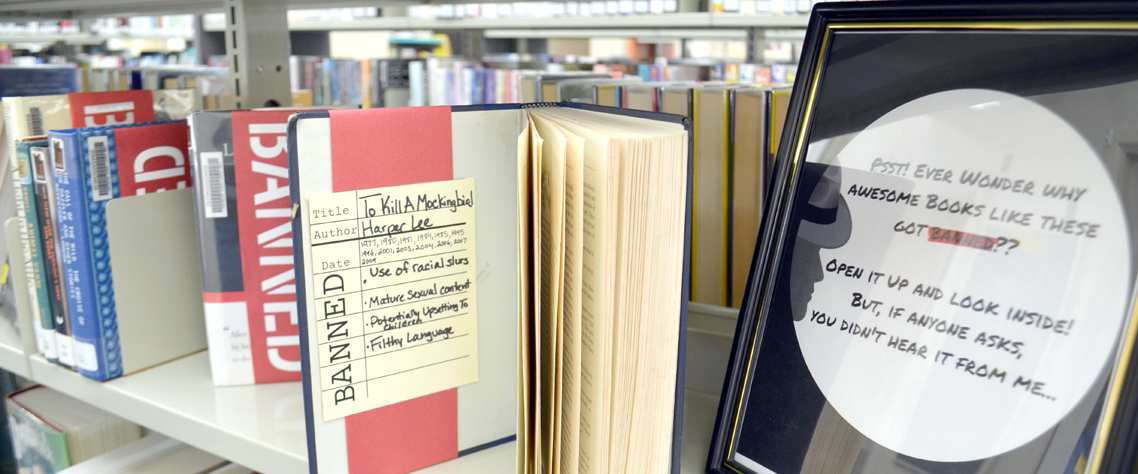
The Lamb County Library participated in National Banned Books week, which ran from Sunday, Sept. 18 through Saturday, Sept. 24, 2022, for the first time.
Banned Books week is a way to highlight the historical attempts to censor books in library’s and schools, according to the American Library Association.
Lamb County Library Assistant, Elizabeth “Peach” Schroeder, said they have interactive displays of banned books at the library.
“We’ve been trying to raise awareness about banned books, so we have multiple displays that people have been interacting with and checking out and learning about why these banned books were banned in the first place,” said Schroeder. “When you open up the books, it actually has like an old fashioned library card inside with the year it was banned and the reasons.”
The amount of banned books that have been challenged or banned has gone up significantly in the last year. According to PEN America 100, from July 2021 to June 2022, 1,648 titles have been banned across 32 states and 138 school districts. In 2020, only 273 books were banned or challenged and 483 books were banned or challenged in 2019, according to the Washington Post.
81 percent. New York has 13 banned books with the second lowest literacy rate at 77.9 percent. Florida has banned 566 books with the third lowest literacy rate at 80.3 percent.
Comparatively, New Hampshire has the highest literacy rate at 94.2 percent, Minnesota was the second highest at 94 percent, followed by North Dakota with 93.7 percent, then Vermont with 93.4 percent and South Dakota with 93 percent literacy rates. These top five states have no banned books, according to the World Population Review website.
According to the NBC News website, the top five of the 50 books Texas parents have tried to ban in 2021: “Drama” by RainaTelgemeier; “When Wilma Rudolph Played Basketball” by Mark Weakland; “Lawn Boy” by Jonathan Evison; “Better Nate Than Never” and “Five, Six, Seven, Nate” both by Tim Federle.
According to the FirstAmendment Museum website, the top five reasons a book can be challenged or banned is because of sexual content, offensive language, unsuitable age group, religious viewpoints and LGBTQIA+ related content.
According to PEN America 100, people or groups who challenge books are typically private individuals, such as parents, organizations, or government officials, but only the Supreme Court can officially ban books.
Elizabeth “Peach” Schroeder, Lamb County Library Assistant, said some of the banned books are surprising, such as “The Giving Tree” by Shel Silverstein and “Charlie and the Chocolate Factory” by Roald Dahl.
“We have a lot of classics, so like ‘The Outsiders’, but apparently John Green people don’t like, surprisingly, ‘Looking ForAlaska’, ‘Paper Towns’,” Schroeder said. “Some of them are surprising, some of them are just classics, like ‘To KillAMockingbird’, stuff about racial injustice, people have a problem with.”
Schroeder also listed the children’s picture book, “Sylvester and the Magic Pebble” by William Steig, the Harry Potter series by J. K. Rowling and “Alice’s Adventures in Wonderland” by Lewis Carroll, as some of the banned books the library offers. Some titles listed may be checked out.
Schroeder said it is important to read banned books because there are things that needs to be talked about that people do not want to talk about.
“Like, in the case of ‘To KillAMockingbird’, people don’t like the way people talk about it, but it’s actually realistic,” Schroeder said. “I think that we feature this, partially because people need to know that these things are banned in other places, so they don’t take it for granted, but also so they open their minds to reading things and get excited about reading things that they might not have read before.”