
It has been more than two years since a trial by jury was held in Littlefield, because of the COVID-19 viral pandemic. Last week’s 6-man, 5-woman jury was the first to hear evidence in the 154th District Courtroom since the pandemic began.
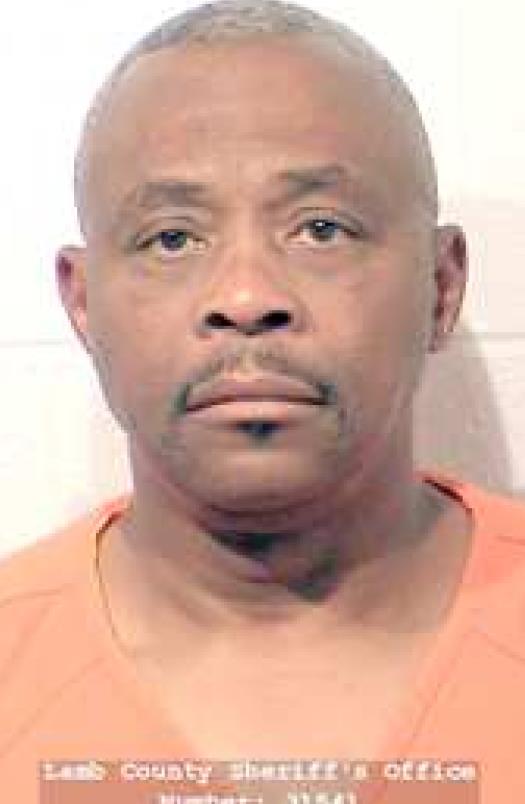
On the third day of the trial, Wednesday afternoon, July 21, 2021, Robert Burns McCall, AKA “Robert Maize,” a resident of the Texas Civil Commitment Center at Littlefield, was found by the jury to be guilty of the charge he’d been indicted for in November 2018. The State alleged that on October 15, 2018, McCall violated a requirement of his Civil Commitment; specifically, that he’d removed the GPS ankle tracking equipment he is required to wear as a condition of his civil commitment status.
The three-day trial began Monday afternoon, when the jury was selected, then testimony began Tuesday morning, after Assistant District Attorney Rickie Redman had read the indictment against Defendant Robert Burns McCall, and both sides presented opening statements to the jurors.
Prosecutors for Lamb County and the State of Texas were County and District Attorney Scott A. Say, and Assistant County and District Attorney Rickie Redman.
McCall’s Defense Attorneys were Cardine Watson and Audie Reese.
The first witness for the State was Mandi Castillo, a Case Manager for the Texas Civil Commitment Office. She testified McCall was one of the civilly committed Sexually Violent Predators on her caseload. During her examination, she answered numerous questions regarding how she supervises her caseload, and about the records maintained on how those clients were doing at the Center.
Redman admitted four documents during Castillo’s testimony, including Orders and Judgment from the 435th District Court of Montgomery County, Texas, which established when McCall was found to be a sexually violent predator. Castillo also brought to Court the ankle monitor McCall was alleged to have removed back in 2018, and it was admitted in evidence.
She testified how the GPS Tracking Equipment (Ankle Monitor) works, and how the monitors used at the TCCC detect when anything is going wrong, whether internally or because they are tampered with. She testified that the monitors will give various types of alerts, such as when they need to be recharged. In other testimony, she noted that satellite issues sometimes require TCCO staff to install a new monitor on a client, but she has heard of a monitor coming off accidentally only one time.
She also testified and demonstrated how the ankle monitor is placed on the ankle.
After some questions from Attorney Cardine Watson, Castillo testified she knew of monitor devices coming off seven times in the four years she has been at TCCC. She later clarified on redirect examination that some of those seven monitors had been intentionally removed by the civilly committed clients—who were then subjected to criminal prosecution for the removal.
When Attorney Watson asked why the residents at TCCC have to wear ankle monitors, since they are locked inside the facility, Castillo explained the residents are ordered by the courts who civilly commit them to wear the monitor, and it is for security reasons if ever a client escapes or absconds, they can be located.
Jonathan “Robby” Demel, the second witness, was a security officer when McCall was in the TCCC, and was working in the area McCall was in on the day he removed his monitor.
Demel testified that his first contact with McCall on Oct. 15, 2018, was after McCall had been placed in a single-occupant room at the TCCC, when McCall told Demel he would rather go back to prison if he was going to be treated like he was in prison. Shortly thereafter, Demel said he retrieved an ankle monitor from McCall, after he heard McCall tapping on the cell window to alert and show Officer Demel the ankle monitor. Demel told jurors when he unlocked McCall’s door and took the monitor from McCall, he asked, “You sure you want to do this?”
The last witness was Littlefield Police Officer Joshua Padgett, who was dispatched to TCCC to investigate the ankle monitor situation. He wore his body worn camera to the Center, where he arrested McCall and took him to the Lamb County Jail for booking. Padgett testified he had to take McCall to the Lamb Healthcare Center for medical clearance, where McCall got medication for high blood pressure. McCall was then returned to the Lamb County Jail, where he was finally booked into jail.
Officer Padgett testified that while McCall was at the LHC, McCall engaged him in conversation. Padgett told jurors that McCall remarked to him, “I’d rather be here, (in jail) than out there (at TCCC). He also said, “if I’m going to be treated like a prisoner, I just as well be in prison.” Finally, Padgett described that McCall told him “I kinda weighed it all out before I did it.” Then, Say moved for admission of a portion of Padgett’s body worn camera video, which showed the conversation Padgett testified to.
After Padgett’s testimony, the State rested its case. Outside of the Jury’s hearing, McCall’s Attorney Reese asked McCall if he wanted to testify on behalf of himself, and McCall declined to testify.
Jurors were excused for a lunch break while the Judge and attorneys worked on the Court’s charge.
When the jury returned at 1:20 p.m., Wednesday, Judge Klein read the charge to them, before each side of the case (prosecution and defense) made their closing arguments to the jury.
At 2 p.m., the District Judge excused the jury and sent them to deliberate.
The jury announced it had reached its guilty verdict only 12 minutes later, at 2:12 p.m.
Once the verdict was read, Attorney Watson asked the Court to conduct a poll of the jurors, where each of them certified they had voted to convict. Then, jurors were excused and thanked for their service. The case then moved to the punishment phase, and since McCall had elected for the Court to assess his punishment, the decision was left to Judge Klein.
When it indicted him, the State notified McCall of three punishment enhancements it intended to argue qualified him as a “habitual offender” under State law. This means that if he were convicted of the charge of Violating a Civil Commitment Requirement, a third degree felony, and if the Court found each enhancement paragraph to be true, the range of punishment would increase from two to ten years in prison, to twenty-five years to life.
The first enhancement paragraph alleged that, on Sept. 21, 1984, in 194th District Court in Dallas, McCall was convicted of the felony offense of Aggravated Robbery Causing Serious Bodily Injury; the second alleged that after being released from prison on the 1984 case, McCall committed the felony offense of Aggravated Sexual Assault with a Deadly Weapon, and was finally convicted on June 4, 1990, in the 283rd District Court of Dallas County; and the third alleged that, after serving prison sentences in the 1990 case, McCall had been released and committed the felony offense of Aggravated Sexual Assault of a Child with a Deadly Weapon, and was finally convicted on Nov. 18, 1994, in the 195th District Court of Dallas County, Texas.
Assistant DA Rickie Redman offered into evidence for the Court McCall’s “penitentiary packet” from the Texas Department of Criminal Justice, which contained all documents and judgments related to those three prior convictions. Attorney Watson objected to the admission of this packet, but Redman argued that the judgments were accompanied by McCall’s fingerprints, signature, and for two of the three, photographs showing it was in fact McCall who’d received those sentences.
District Judge Felix Klein sentenced McCall to serve 25 years in the Texas Department of Criminal Justice’s Institutional Division.
Say and Redman both wish to express their sincerest thanks to the jurors, without whom they say they could not do their jobs, of seeking justice. “It had been so long since we’d asked people to come to the courthouse for jury duty for a trial, and we weren’t sure how many would show up—but this process went so well.” Redman continued, “Scott and I are so thankful to each of the people summoned who came, because we know this process takes a lot of time away from everyone’s day-to-day lives and schedules. We are even more appreciative of those who served as jurors in this case, for their careful attention during the trial, and their willingness to follow the law and hold McCall accountable for his choices back in October 2018.” Both prosecutors hope the quick verdict from the jury, and punishment handed out by the Judge, will send a message that they take this crime seriously and will continue to prosecute it, to ensure the safety of Lamb County residents.