
Cotton Crop & Pest Situation
Not much has changed over the last couple of weeks in cotton other than the physiological state of the cotton itself. We have moved from 5 nodes above white flower (NAWF) on August 5 to less than 2 NAWF here on the 19th. The +95-degree temperatures have made this happen. We have consistently been in the 22heat unit/day (DD60) most all the month of August and a good part of July. When it comes to insect pests though we can’t quite stick a fork in it yet. I am still checking fields with cotton aphids and am on the alert for bollworms, Lygus and stink bugs. This is especially true in cotton which has late growth, non-BT cotton, or may have excessive or late applications of nitrogen. Most cotton will need to be monitored for at least another 10 days, maybe through the first week in September for later cot-ton. Cotton is generally safe from most pests when approximately 400 heat units (about 20 days) past the 5 nodes above white flower have accumulated. Cotton aphids, Lygus and stink bugs would be insects which I never completely turn my back on up through boll opening.
Cotton irrigation is still very critical with very limited rain showers. Cotton is still needing from 0.15” to 0.25” per day. This is down from near 0.30” per day at the peak just a few days ago. Evapotranspiration will decrease as temperatures moderate and day length decreases. Weeds continue to be a concern for some. Be careful in your enthusiasm to kill these weeds. First ask if these weeds are just cosmetic at this point or will their seed production haunt you in the future (i.e. morningglory, pigweed) or cause you harvest problems. I am seeing many fields with large pigweed being hoed. I applaud your effort, albeit costly. But most likely those weeds represent a real hurdle to harvest. Young flushes of weeds, however, control may not be necessary. In some situations, you might just save money for a good harvest aid program and be prepared to do a much better job next year with residual herbicides.
WEEDOFTHEWEEK
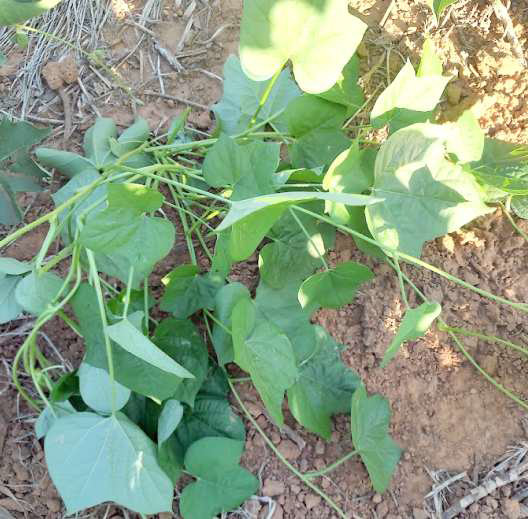
Morningglory, Ipomoea spp. Convolvulaceae family
• Morningglories, often called annual morningglories, are summer annual or perennial broadleaf plants.
• Morningglories are often cultivated as ornamentals, however, under favorable conditions they can become troublesome weeds particularly in cotton as it blends in with the cotton as shown below and quickly climb and run down the plant row.
• Most seedlings emerge following irrigation or rains, but they may also appear when surface soil is too dry to allow germination of other annuals.
• Cotyledons (seed leaves) are butterfly shaped and more deeply notched and much larger than those of field bindweed.
• First true leaves are heart shaped with deep lobes at the base.
• Mature plants have long stems that climb and twine.
• Leaves are large, heart shaped and/or three lobed, and are alternate to one another along the stem. Both leaf types can occur on the same plant.
• The funnel-shaped flower varies in color depending on the species, from violet or blue to pink and red.
• Fruits are pods that release seeds through slits.
• Seeds germinate down to a depth of 4 inches (10 cm) or more, much deeper than most annuals. ***** West Plains IPM Update is a publication of the Texas A&M AgriLife Extension Service IPM Program in Hockley, Cochran, and Lamb Counties.