
Cotton here in Hockley, Cochran, and southern Lamb counties ranges from just beginning to bloom (very late) with more than 6 nodes above white flower (NAWF) to hard cutout with <2 NAWF. Using our IPM scouting fields as a representation of the area cotton crop, we see that 25% of fields have reached physiological cutout (5 NAWF or fewer) this week. For those fields we need approximately 400 more heat units (HU) to accumulate to be safe from bollworms. With the current weather trend of +20 heat units per day, those fields which have reached cutout should be safe from bollworms around August 25. The remaining 75% of the cotton acreage has such a wide range of maturity levels that I would be remised to say when those fields might be safe from worms. I would approach these later maturing fields from this angle. We historically say our last effective bloom date is August 20th. This is a date in which a boll can be formed, have time to mature, and contribute to yield. Therefore, if we continue with this weather pattern into September, and we are accumulating even 18 HU/day, we can add 22 days to this date. Thus, would give us a target of September 11 for those late fields needing to be scouted and protected from worm issues. The point being is that NAWF is an important gauge of maturity and can help project time needed to be safe from worms and even manage irrigation.
Currently, bollworms are just beginning to be found infesting area fields and need to be scouted, particularly those varieties with no Bt technology. Lygus, stinkbugs, and cotton aphids should be included in those scouting procedures. Cotton aphids have been the most common insect across many acres. To-date beneficial spiders and insects as lacewing and lady beetles have kept up and disposed of infestations. Remember, cotton aphids thrive in skippy cotton, and excessive/late nitrogen. Late nitrogen can also delay cotton maturity. For more information on managing cotton insect in Texas go to: https:// lubbock.tamu.edu/files/2019/08/ 2019- Cotton- Insect- Control Suggestions_ENTO090.pdf My priority list for the rest of August, and going into September: 1. Keep a close watch on cotton bollworms, larva pests in general, cotton aphids and Lygus. Scout, apply economic threshold, act on good information.
2. Continue with late season weed control: residual herbicide, cultivate, hoe, whatever it takes to keep Palmer amaranth from going to seed. It is a numbers game.
3. Be careful when irrigating not to cause additional vegetative growth resulting in delay of plant maturity. The goal is to finish blooming before the end of August.
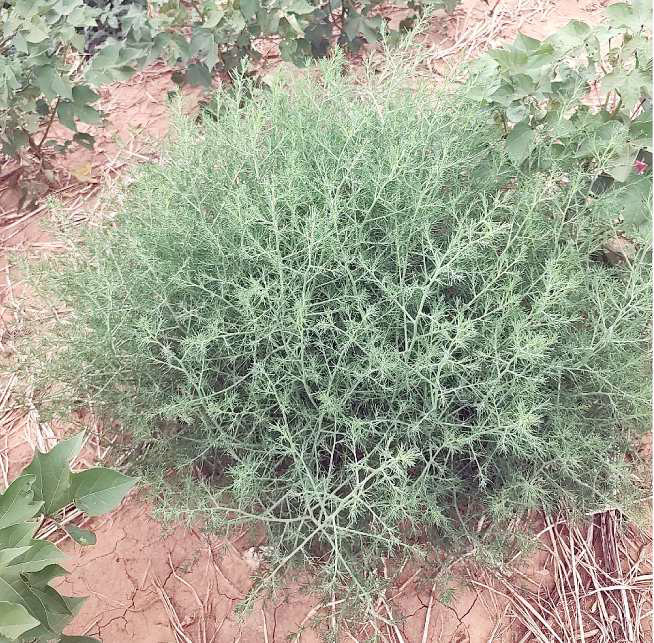
WEEDOFTHEWEEK Russian Thistle, aka Tumbleweed, Salsola iberica Chenopodiaceae (Goosefoot) family • Tumbleweed is a many branched, annual herb growing to 2 to 6 feet tall. At maturity, the plant is stiff, prickly, round and bushy. The spine-tipped leaves are oval. The stems have distinctive dark purplish striations (parallel to the stem) when the plant is young and growing.
• Tumbleweed is found in every region of Texas except the Piney Woods and Post Oak Savannah. It is most abundant along roads, in irrigated fields and in disturbed areas.
• Most seed germinate the spring following maturation. Seed can germinate when night temperatures are below freezing, and daytime temperatures reach 2o C. Optimal temperatures for germination are between 7 and 35o C (45 and 95o F). Germination requires little moisture (0.3 inches of rainfall) and occurs within a few hours. Successful germination requires loose soils. Seedlings that germinate on firm soil seldom survive because radicles are unable to penetrate the soil. Seed in the field typically remains viable for only 1 year, some up to 2 years, rarely to 3.
• Plants about 0.5 m tall can produce about 1500-2000 seeds, and large plants can produce up to 100,000.
• Seed disperses when plants break off at ground level and tumble with the wind.
• Introduced from Eurasia.
• Typically infests sandy soils on disturbed sites, waste places, roadsides, cultivated and abandoned fields, disturbed natural and semi-natural plant communities.
• Is a known host to southern root-knot nematodes which infest cotton.
***** West Plains IPM Update is a publication of the Texas A&M AgriLife Extension Service IPM Program in Hockley, Cochran, and Lamb Counties.