
Cotton still ranges from the good, the bad, and the ugly. Since we are just a week out of my target date (August 5) of having 5 nodes above white flower we should already be in the 5-7 NAWF range. More than that may push maturity too late. Having fewer than 5 now would not be taking full advantage of the “effective bloom period”. I will reiterate that we make cotton in August.
Insect pests have picked up somewhat over the last few days. Cotton aphids are becoming more common, but very good numbers of beneficials are present in those situations keeping them in check. I can find cotton fleahoppers occasionally but am not seeing fruit loss on young squaring cotton. I have seen some cotton bollworm damage in terminals but have not found any worms. Just be aware that activity of bollworm increases as we go into August. Watch your conventional varieties. We are keeping an eye out for Lygus and other plant bugs. My priorities for the next few weeks are: 1. Keep up with crop water demands, we are nearing peak use in flowering cotton of 0.30” per day.
2. Wrap-up fertilizer applications by the first of August, or at least before 5 NAWF. Late applications only delay maturity and can encourage cotton aphids.
3. Keep a close watch out for cotton aphids, Lygus, stinkbugs, and cotton bollworms over the next 3-4 weeks.
4. Do not let cotton vegetative growth get out of hand. Our target of 5 NAWF should be reached around August 5th. This allows us to literally bloom out the top by the last effective bloom date of approximately August 20. Come Oct. 1 or 40 days after August 20, heat units basically stop accumulating for cotton.
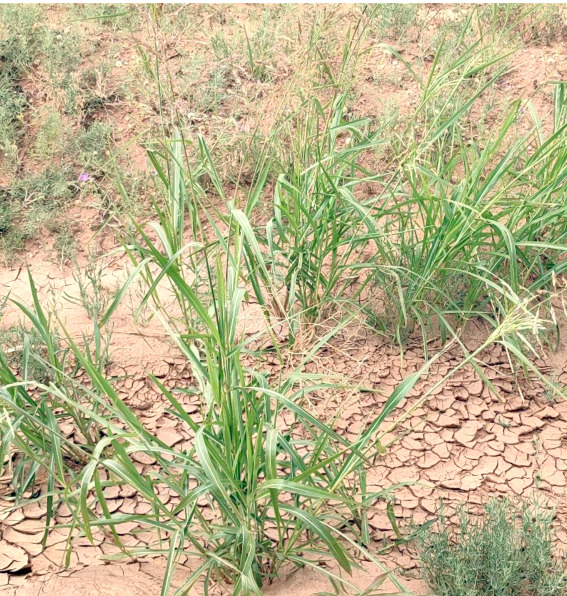
WEED OF THE WEEK Johnsongrass, Sorghum halepense Poaceae (Grass) family
• Johnsongrass has been used for forage and to stop erosion, but it is often considered a weed.
• Foliage that becomes wilted from frost or hot, dry weather can contain sufficient amounts of hydrogen cyanide to kill cattle and horses if it is eaten in quantity.
• The foliage can cause ‘bloat’ in such herbivores from the accumulation of excessive nitrates; otherwise, it is edible.
• It grows and spreads rapidly, it can ‘choke out’ other cash crops planted by farmers.
• This species occurs in crop fields, pastures, abandoned fields, rights-of-way, forest edges, and along streambanks. It thrives in open, disturbed, rich, bottom ground, particularly in cultivated fields.
• Johnsongrass that is resistant to the common herbicide glyphosate has been found in Argentina and the United States. It is considered to be one of the ten worst weeds in the world. In the United States, Johnsongrass is listed as either a noxious or quarantined weed in 19 states.
• Johnsongrass is a known overwintering site for the Sorghum aphid (Sugarcane aphid). A common pest of grain sorghum.
***** West Plains IPM Update is a publication of the Texas A&M AgriLife Extension Service IPM Program in Hockley, Cochran, and Lamb Counties.