
CURRENT SITUATION– Cotton ranges from 5 leaf stage to 13 true leaves with square set good at +90%. As of today, I have not seen a single cotton bloom. I do anticipate seeing a few first blooms this coming weekend (July12-15). However, I do not anticipate seeing a blooming field (when +50% of plants are blooming in a field) until after July 20th. We typical go into bloom with 8 nodes above white flower. To do this, we need to form 4 additional squares. It will take 3 days per square to form, this equates to 1112 days. This places first bloom on July 20th on this more progressed field. Majority of fields then will be after this date.
Cotton insect pests remain very quiet. In the IPM Scouting Program we have noted only an occasional fleahopper, and no Lygus (only finding them in weedy barditches) or stink bugs. We can find grasshoppers on field margins near rangeland. Beneficial insect and arachnid numbers are surprisingly good in some fields, though limited food source is available. I suspect these are residual populations from wheat.
Weeds continue to be the most dominate pest. A long-varied list of weed species noted throughout all three counties. If you need help identifying a weed and coming up with a control plan, give me a call. Remember, these weeds serve as host to many of our cotton pests.
A good majority of you have received some rain over the last week. Some more, some less. Cotton should respond well to these rain showers, especially dryland acres. Obviously there have been major hurdles to get to this point and most likely some of those will continue. I am optimistic for most of our area dryland and irrigated cotton. In fact, you may need to add to your “to do” list an application of an PGR if you have not already done so. Between many now considering upping their fertilizer game, and good soil moisture going into July, cotton plants should make good progress in growth.
WEED OF THE WEEK
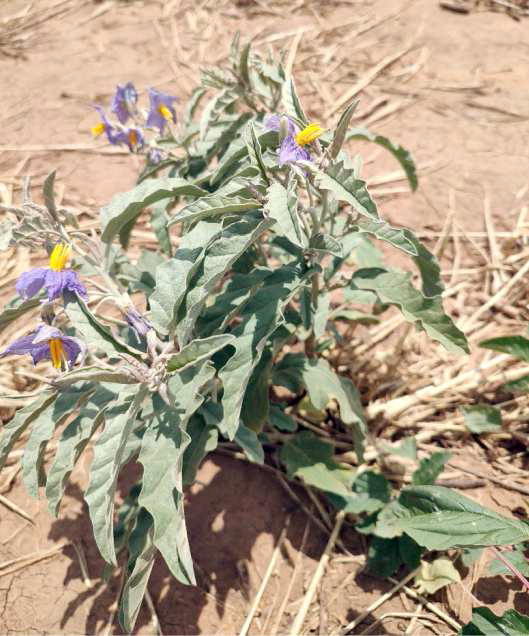
Silverleaf nightshade, aka Whiteweed Solanum elaeagnifolium Cav.
Solanaceae (Nightshade family)
• Silverleaf nightshade is an upright, usually prickly stemmed perennial in the Nightshade family.
• It grows 1-3 feet tall.
• The plant reproduces by seed and creeping root stalks.
• Has a silver color which is imparted by tiny dense hairs covering the entire plant.
• Leaves have a wavy margin and a lance shaped to narrowly oblong.
• Has showy violet or bluish (sometimes white) flowers.
• Developed fruit is round, yellow, near 1D2 inch in diameter from May to October.
• In relationship to cotton it is a great source, as it is a preferred host, to the cotton fleahopper. Managing this weed during the first month of cotton squaring can be problematic in that it can cause fleahoppers to move in mass to cotton causing square loss from feeding damage.
***** West Plains IPM Update is a publication of the Texas A&M AgriLife Extension Service IPM Program in Hockley, Cochran, and Lamb Counties.