
CURRENT SITUATION–
Cotton here on the west plains of Texas ranges from pinhead square to peak bloom (5 nodes above white flower [NAWF]). Ideally, we would like to be around 6-7 NAWF at this time. This allows us to take full advantage of an “effective bloom period” and have that last bloom set before odds decrease dramatically for full maturity. The last effective bloom (high probability that a bloom will result in a harvestable boll) date ranges from August 7-20. As the adage goes – “we make cotton in August” will hold true for this year. Also, we are hopeful that more moderate tem- are coming, not the +95degree temperatures we have had. This will allow cotton to grow at a more normal pace rather than racing towards hard cutout. This will also allow rain and irrigation water to be more efficiently used.
Insect pests remain relatively few. Fleahoppers have had their time the past several weeks but will become less important as we move into August. We are keeping an eye out for Lygus and other plant bugs as well as cotton aphids. Beneficial insects and spiders have been present in most fields to help if needed.
My priorities for the next few weeks are: 1. Keep up with crop water demands, we are nearing peak use in flowering cotton of 0.30” per day.
2. Wrap-up fertilizer applications by the first of August, or at least before 5 NAWF. Late applications only delay maturity and can encourage cotton aphids.
3. Keep a close watch out for cotton aphids, Lygus, stinkbugs, cotton bollworms, and even beet armyworms over the next month.
4. Maintain our good square set going into flowering on late cotton and maintain a good boll set with limited damage and losses.
5. Do not let cotton vegetative growth get out of hand. Our target of 5 NAWF should be reached around August 5th. This allows us to literally bloom out the top by the last effective bloom date of approximately August 20.
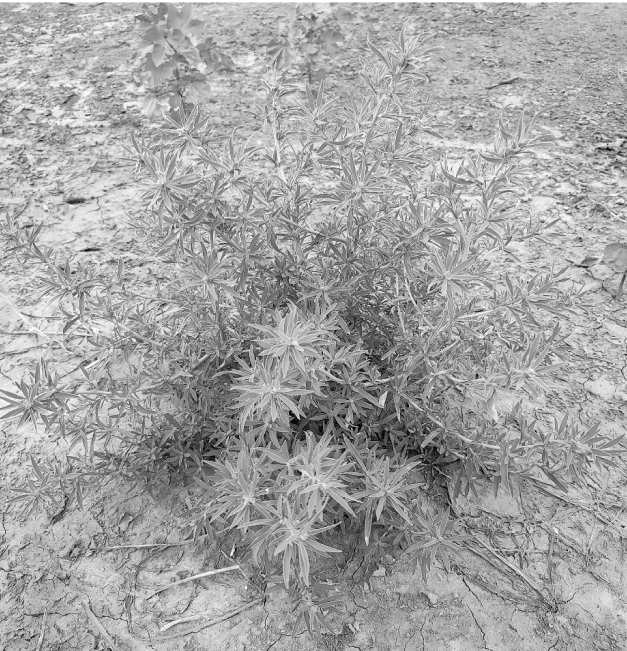
WEED OF THE WEEK
Kochia, aka. Ironweed, or Burningbush, Bassia scoparia Chenopodiaceae (Goosefoot) family • Kochia is an introduced, annual forb growing from 2 to 5 feet or 0.6 to 1.5 m tall beginning in late spring.
• Kochia forms in a pyramidal or rounded shape from a taproot system that reaches around 8 ft or 2.4 m in depth.
• Stems are erect, much branched, and leafy.
• Leaves, arranged alternately on the stems, turn bright red with age. The leaves are simple, linear to narrowly ovate, may have hairs, and reach about 5.5 cm long.
• Kochia’s flowers are inconperatures spicuous, grow on a spike, and are green leaf-like bracts that are surrounded by tufts of hair. It has an utricle fruit that houses a single, oval, and brown to black seed.
• When it is mature, Kochia breaks at the base and becomes a tumbleweed which aids in seed dispersal.
• Interest in the plant as a feed source has been high because it can produce the same amount of forage per acre as alfalfa with half the water; hence, the plant is often called “poor man’s alfalfa.”
• During early growth, Kochia is palatable and has high forage value for all species of livestock which can be grazed or hayed. It provides shelter for wildlife, and the seeds are consumed by songbird and game bird species. Foliage is also consumed by deer and pronghorn.
***** West Plains IPM Update is a publication of the Texas A&M AgriLife Extension Service IPM Program in Hockley, Cochran, and Lamb Counties.