
CURRENT SITUATION– Many producers’ crops have been through the wringer the last several weeks. My prayer now is that we have good open weather from here on out with gentle, timely rains, and a great long fall. On the bright side many farms have good soil moisture for mid-July and the temperatures are generating good heat units (19- 21 DD 60’s per day).
Based on the scouting fields here is what the average upland cotton plant looks like: Average number of total nodes is 13 (range 6 to 16) 1st fruiting branch at node 7 (range 5-9) Averaging 7 first position squares from nodes 7 through 13 Square retention of 1st positions is 91% (range 69-100%) Node length is 0.85' (range of 0.4'-1.4') Plant populations average 38,650 per acre (range 18,700 to 46,000) Nodes above white flower 8.2 (currently 12% fields with first bloom) I began finding blooms last week, Thursday, July 11. I project we should go into bloom with 8.5 nodes above white bloom. We are averaging 7 first position squares currently. We will need to form another 2-3 squares which will take 6-9 days. So, in general the average field this year should see first bloom near July 21-24. This is close to my projection two weeks ago. The sooner the better is an understatement. It remains very quiet currently on the cotton insect front. I would really watch fleahoppers and Lygus on this late cotton that is squaring up.
I have seen and have had producers comment that they have seen the Mozena plant bug. This is the plant bug, which is often associated with legumes, especially mesquite in our area. Rarely do we see any damage from this insect. Grasshoppers also continue to be present in many fields.
My priority list for this upcoming week: 1. Keep close watch fleahoppers and Lygus on young squaring cotton. 2. Stay on top of weed control, cultivate, hoe, whatever it takes to keep the pigweed from going to seed. It is a numbers game. 3. If you still have fertilizer to go out get it in place before the end of this month. This applies even to late cotton. Late fertilizer applications will only delay maturity and can encourage cotton aphids. 4. Look at the top 3-4 nodes on your cotton if the internode length is longer than 1.5' consider a plant growth regulator. Call and we can visit.
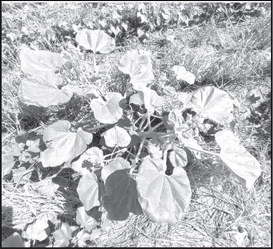
WEED OF THE WEEK Devil’s Claw, aka. Unicorn plant, Proboscidea louisianica ( Mill.) Thell. Pedaliaceae (Sesame) family
• Devil’s claw is a low, spreading annual, bushy plant, 1- 2 ft. tall, with large, long-stemmed, palmately lobed leaves. Often found on sandy soils.
• Leaves, 5-inches across and up to 1 foot long, covered with glandular nectar which often collects sand particles.
• Its creamy-yellow, tubular, five-lobed flowers are spotted with purple and appear in fewflowered, axillary clusters after summer rains.
• The fruit is a fleshy capsule, curved pod that splits into two “claws” when it dries.
• The name “unicorn plant” refers to the remarkable fruits. These are at first fleshy, the flesh later falling away, leaving an inner woody shell tipped by a long, curved beak (the horn of the unicorn). The beak splits lengthwise, and the shell opens between the two parts of the split beak. These fruits are easily caught on the legs of deer, rabbits, and cattle or hooked in the wool of sheep by their spreading claws (thus the name “devil’s claw”).
***** West Plains IPM Update is a publication of the Texas A&M AgriLife Extension Service IPM Program in Hockley, Cochran, and Lamb Counties.