

The USDA National Agricultural Statistics Service (NASS) released final county production estimates It’s raining across many parts of the Cotton Belt – in some case, too much for planters to make significant progress. In other areas, cotton is already up to a stand. And in West Texas, growers are moving quickly to take advantage of recent rains.
Here’s what our contributing consultants had to report for mid-May.
Kerry Siders, Texas A& M AgriLife Extension Agent-IPM for Hockley, Cochran, and Lamb Counties.
The Texas High Plains has, in the past week, finally received some general rains, with 1” or better being measured. For my area around Levelland to the New Mexico state line, this is the first good measurable rain since the first of the year.
There has been some planting of pivot irrigated land over the last 10 days or so, but with rain and rising temperatures, most all irrigated acres will now be planted and then dryland acres. We are seeing a slight uptick in the use of Enlist technology from PhytoGen, most likely due to the Xtend technology scare a few months ago. Right now, the Xtend situation has settled for this growing season. It is good to have all these tools available.
With the recent rains we’ll need to watch for increasing weed pressure and even insect pests which weeds will host initially. Fortunately, I am not picking up much activity in terms of thrips or other foliar feeding insects currently. I am concerned about wireworms, especially where we have had wheat cover or a previous grass crop.
If you need help scouting or with other issues which you will deal with in the production of cotton, I would highly recommend you hire a professional crop consultant.
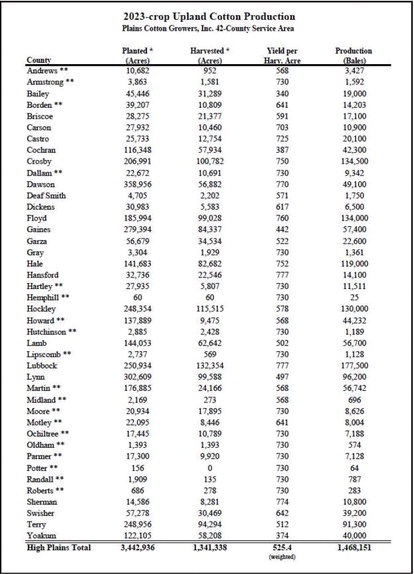
for Upland cotton on Friday, May 10 and the data shows Texas produced 2.7 million Upland cotton bales in 2023. Texas High Plains cotton production is an estimated 1,468,151 bales for the year.
Among High Plains counties that have official NASS data to review, only 5 counties produced more than 100,000 bales in 2023.
Those counties were: '
Lubbock 177,500; Crosby – 134,500; Floyd – 134,000; Hockley – 130,000; and Hale – 119,000.
According to the January 2, 2024 USDA Farm Service Agency (FSA) Certified Acreage report High Plains producers planted 3.442 million acres in 2023, while acres remaining for harvest totaled 1.341 million. Weather related losses led to 60% abandonment of planted acres in the region.
The USDA NASS data is a testament to the tough growing conditions that plagued the state in 2023. Unfortunately, the agency only published county-level data for 61 of the 162 counties that planted cotton in 2023, which equates to only 38% of raw data reported.
Only 22 counties in PCG’s 42county service area had official USDA NASS data released. Production from the remaining counties was estimated using a calculated USDA NASS district average yield from published county data and January certified acreage data.
The preceding paragraphs lead to a question of NASS relevancy. Is this USDA faction useful anymore? Given their recent discontinuation of the cotton objective yield survey and all county estimates for crops and livestock, which is data that industry has relied upon for years, it’s certainly something to think about. While we appreciate our colleagues at the state and regional offices who strive to do their job, the necessity of this entity, given the way they operate at the federal level, is definitely questionable.