
Texas fruit growers are facing a difficult season due to a combination of inconsistent winter chill and damaging spring freezes.
Fruit trees, including peaches and plums, rely on a period of winter dormancy, triggered by a specific number of “chill hours” or periods of cold weather that help trees reset and prepare for spring growth.
In Texas, where winters can be unpredictable, achieving the right number of chill hours is increasingly uncertain.
“This year, chill was marginal,” said Larry Stein, Ph.D., Texas A&M AgriLife Extension Service horticultural specialist and professor in the Texas A&M Department of Horticultural Sciences, Uvalde. “It wasn’t the best, but it wasn’t the worst. Trees did bloom but then we had freezes.”
Barely any chill
When freeze events hit after trees bloom, it can damage fruit sets and compound chill hour challenges.
“We’re dealing with a double whammy,” Stein said. “Not only was the bloom sporadic due to marginal chill, but the freezes killed some of the early fruit.”
Texas growers are seeing uneven tree production, with buds emerging inconsistently across branches.
“A well-chilled tree will leaf out all at once. But when chill is lacking, the growth is patchy,” Stein said.
Varieties matter
To avoid a disappointing crop, Stein said the importance of choosing fruit tree varieties suited to the specific chill requirements of Texas’ regions is critical.
Growers and home gardeners should consult with local county AgriLife Extension offices and use resources like the Aggie Horticulture website, which features maps and fact sheets outlining chilling zones and variety recommendations, he said. “If you pick a variety that needs too little chill for your area, it’ll bloom too early and get frozen out,” Stein said. “If you plant one that needs too much chill, it may never bloom or leaf out properly.”
With chill hours becoming less predictable because of climate variability, Stein said selecting the right variety is more crucial than ever.
“Chill is a real thing,” he said. “And it can make or break your fruit crop.”
CROPANDWEATHERREPORT
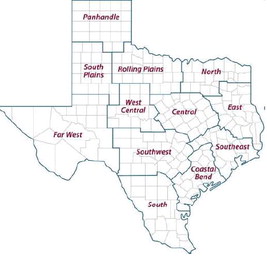
AgriLife Extension district reporters compiled the following summaries:
Rolling Plains
Recent rains brought muchneeded moisture to the district, offering a timely boost to crops and forages. While rains improved topsoil moisture, subsoil levels remained below optimal for sustained crop growth. Farmers were cautiously optimistic and recognized more rain was needed. Reports indicated most winter wheat was headed out. However, producers noted that plant heights were noticeably shorter than average, and no rust was reported. Improved moisture levels benefited grazing pastures. Cattle grazed on greener, more abundant forage. There were reports of an increase in weeds, and many producers planned to apply herbicide soon.
South Plains
The district experienced windy and dry conditions. A few farmers planted corn and sorghum. Others prepared beds for upcoming planting. Farmers across the district sprayed and fertilized for planting season. Livestock remained on supplemental feeding, but warm-season grasses began to emerge.
Panhandle
The district received about 1 inch of rain and 2-4 inches of snow. The moisture was extremely beneficial for producers as corn planting was set to begin soon. Soil moisture was very short to adequate. Cotton planting was expected to begin the first of May, and sorghum planting was planned for the latter part of May into early June. Top dress fertilizer applications were made to many small grain fields for grain and forage under both dryland and irrigated conditions. Wheat responded well to the recent moisture, especially the dryland. Wheat grew and developed at a rapid rate. Rangelands greened up. Gains in stocker cattle were excellent on graze-out wheat. Pasture and rangeland conditions were reported from poor to good. Overall crop conditions were fair to good.
Far West
Unseasonably warm temperatures were reported, with temperatures in the upper-90s. Fortunately, winds were not as intense as in recent weeks. No precipitation was reported, causing moisture losses above normal for this time of year. Melon planting was in full swing. Corn planting was completed, but not all fields emerged due to lack of moisture. Sorghum planting began. Wheat in areas that received heavier rains improved noticeably and may make it to harvest. Fieldwork increased, and growers prepared for cotton planting. Irrigating from wells was difficult in some areas, and cottonseed germination was expected to be difficult. Some producers considered not planting until rainfall improved moisture levels. Area livestock had very little to graze on, and their diets were supplemented. Producers started to shear and mark late lambs.
West Central
Cold weather and some frost occurred, accompanied by high winds. Recent rains improved con-
A map of the 12 Texas A&M AgriLife Extension Service districts.