
Plains Cotton Growers Across the Texas High Plains, the difference between a cotton crop with potential and one nearing abandonment can be as little as the width of a county road.
In some fields, adequate irrigation is sustaining good fruit loads and keeping yield potential alive. Directly across the road, dryland cotton is short, stressed and rapidly running out of time. After weeks of intense heat, limited rainfall and high water demand, the 2026 crop is increasingly being divided by one simple factor: who has water and who does not.
Scattered rainfall in late July and earlyAugust offered temporary relief in portions of the region, but it was far from enough to change the broader picture. Some areas received meaningful moisture, while others caught only a few tenths or missed the rain altogether. With crop water use remaining high, that moisture disappeared quickly.
Now, as cotton moves through a critical stage of development, the window for rain to make a meaningful difference — particularly on dryland acres — is closing fast.
Conditions remain highly variable across the region. Some of the better-looking cotton is south of Lubbock, where earlier rainfall helped establish and sustain the crop. In Martin County, dryland cotton planted in early June was still holding on relatively well in late July after benefiting from good rainfall and a favorable cover crop. Near Slaton, Texas, a lightly irrigated field with roughly 5.2 inches of rainfall since planting also continued to hold on, although additional moisture will be needed to finish the crop.
Southeast Lubbock County offered another example of what adequate water can mean this year. Cotton under approximately four-gallon irrigation was performing well at peak bloom, with the system supplying enough water to cover much of the crop’s daily needs.
But fields with less irrigation capacity are increasingly showing the effects of the deficit. A two-gallon drip field north of Levelland, Texas, was still performing relatively well considering its limited water, but irrigation alone was falling short of peak crop demand.
Similar differences can be seen across Crosby and Floyd counties, where some irrigated fields continue to show good potential while nearby dryland acres deteriorate.
The situation becomes particularly concerning north of Lubbock.
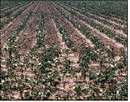
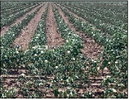
Driving through the Petersburg, Texas, and Plainview, Texas, areas, dryland fields showed a remarkably consistent pattern: good stands that had established earlier in the season but now were extremely short and already blooming out the top. In some cases, plants were only several inches tall. Near Petersburg, Texas, the divide was especially striking. A severely stressed dryland field sat almost directly across the road from well irrigated cotton — a clear illustration of just how much water is determining the outcome of the 2026 crop.
Even among irrigated acres, however, producers are being forced to make difficult decisions about where limited water can do the most good. In Floyd County, one producer was diverting water from a lower-potential pivot to another field with better prospects. Farther north, some Panhandle producers have considered shifting irrigation away from severely stressed corn and toward cotton with greater remaining yield potential.
Those decisions reflect the balancing act producers face as water supplies are stretched across multiple crops.
For dryland cotton, there is considerably less flexibility.
A Swisher County field planted behind wheat fallow was still hanging on in late July, but without additional rainfall its prospects were fading quickly. When asked whether an inch of rain during the latter half of August could still make a difference, the assessment was clear: by then, it would likely be too late.
Rain needs to come much sooner.
That does not mean later August rainfall would be without value. Timely precipitation could still provide substantial help to irrigated cotton, allowing producers to supplement declining well capacity, reduce irrigation costs and give developing bolls the moisture needed to finish.
But for the most stressed dryland acres, the crop is reaching a point where additional moisture may arrive too late to substantially change the outcome.
The difficult season also is providing a revealing test of production practices designed to make better use of limited moisture.
Research trials throughout the region comparing traditional and wider row configurations are showing noticeable differences under drought stress. In several locations, cotton planted on 60- or 80-inch rows has continued to hold on longer than cotton planted on narrower rows.
The wider configurations allow individual plants more room to develop root systems and access available moisture. Research to date suggests wider rows can offer an advantage on a peracre basis in dryland or lowyield environments, while traditional 40-inch rows generally become more advantageous as yield potential increases.
Seeding rate, by comparison, has produced relatively little difference in yield or fiber quality. Cotton’s ability to compensate for variations in plant population gives producers considerable flexibility in seeding rates, while row spacing appears to have a much more significant effect under limited-water conditions.
Those findings take on added significance in a season when every available inch of moisture matters.
There is still good cotton across the Texas High Plains, and some irrigated fields have meaningful yield potential if producers can keep water underneath them and receive timely rainfall. But the number of those fields becomes smaller as water availability declines.
For dryland producers, the situation is considerably more urgent. Fields that began the season with promising stands are rapidly reaching their limits, and rainfall that might have dramatically changed their prospects a few weeks ago may soon do little more than arrive too late.
The 2026 crop is not finished yet, but for a growing portion of the Texas High Plains, the next rain may determine whether there is a crop left to harvest.